

Home › Forum › Ask A Member › OMC Kill-switch question › Reply To: OMC Kill-switch question

Long, hot, humid weekend….too hot to be tearing into an engine, but whatchagonnado, right?
– Flywheel off…it’s a 1-magnet wheel. That lays that theory to rest.
– Points…at any given moment in one revolution of the crank, at least one point is grounded to the mag plate (and the mag plate is well grounded to engine frame…zero ohms). Absolutely, joining these points to one another should kill the engine.
– Vacuum switch / points are wired correctly.
I put it all back together and fired it up. Runs great, can’t wait to get to Maine in a few weeks and enjoy some lake time. But the kill switch (on the dash of the boat) doesn’t kill the engine. Stutters & runs like crap, but kill? Nope. I figured maybe it was the wiring from my transom to the dash. Rung everything out, and it’s fine.
So the next step was to hook up 2 switches directly to the engine to see if the issue was on the engine or elsewhere….i.e. “Am I looking in the right place?”
Switch “A” is a conventional “tie the points together” kill switch, wired directly to the points. Switch “B” is a supplemental switch to test my theory in the original post.
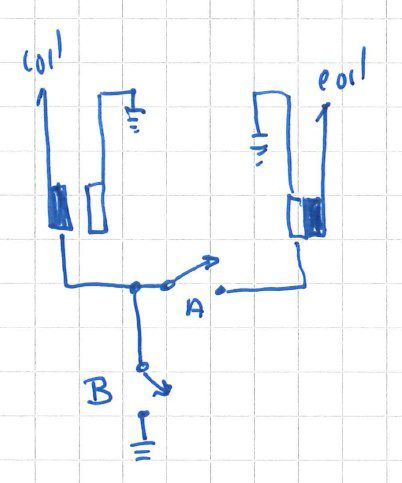
Fire up the engine, increase the revs a bit, and close switch “A”. As with the similarly-connected switch on the boat’s dashboard, the engine stutters & runs poorly, but doesn’t shut off.
With switch “A” still closed (and the engine stuttering), I closed switch “B”, thereby tying the still-joined-points directly to ground. The engine died instantly.
While I remain curious as to why switch “A” (alone) didn’t accomplish the task, I’m perfectly happy to change the kill switch on the dashboard to a DPST switch as shown in my original post…now that I know such will accomplish the goal.