

Home › Forum › Ask A Member › Recharge Magnets on Fly Wheel › Reply To: Recharge Magnets on Fly Wheel

Mr. Tubs has made the following claims about flywheel magnets:
1) That “it is the speed that the magnet passes over the coil that intensifies the spark, not how strong the magnet is”
2) That “increasing the magnetism wont make the spark any stronger as demonstrated in a video”
3) And, that “After WW-II motors have permanent magnets. Attempting to recharge them will destroy them and they cant be repaired.”
Wow….I hardly know where to begin. I guess I’ll address these in numeric order……
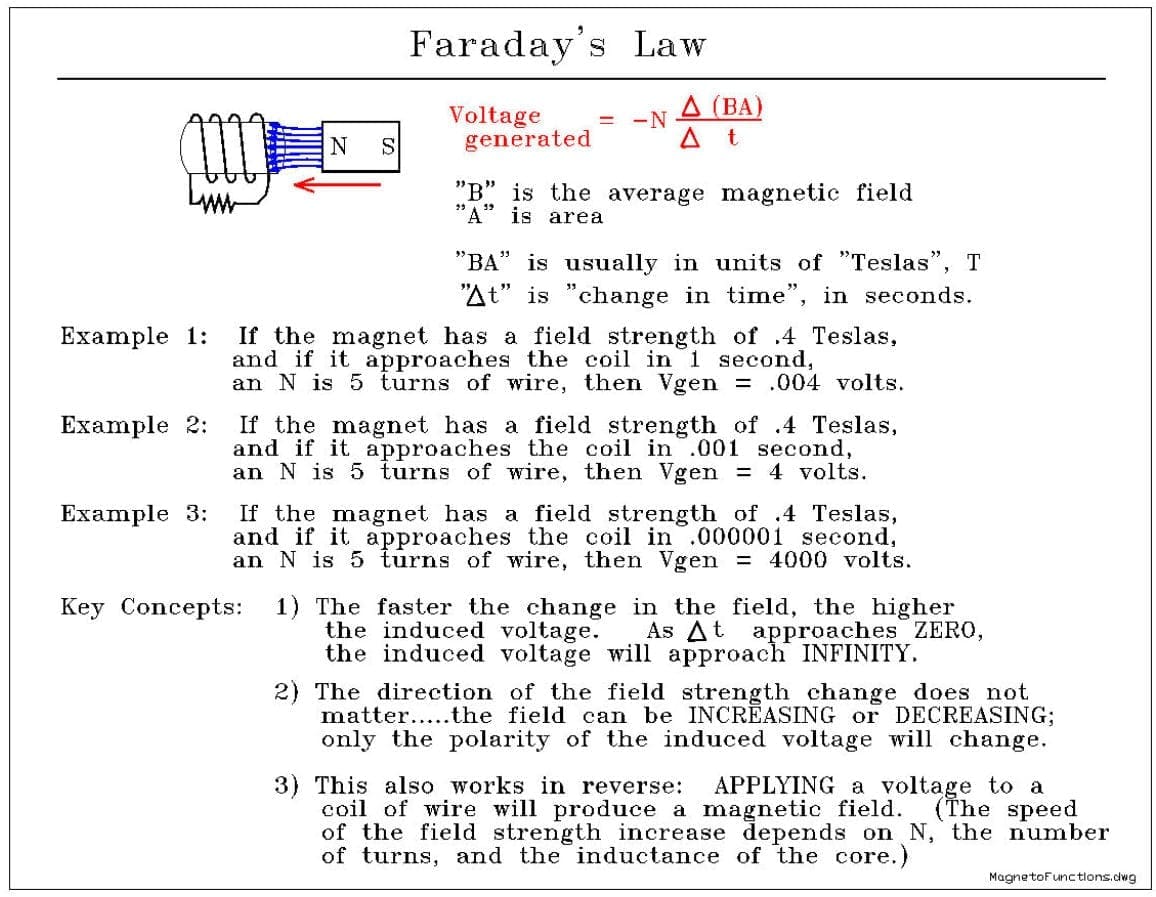
Look at the first attachment (below)…….either Faradays_Law.PDF for Faradays_Law.jpg <– Whichever of these pictures you can view
This is the equation for how much voltage is generated in a coil when a magnet passes by. The voltage, according to the formula,
is equal to the NUMBER OF TURNS in your coil, multiplied by the STRENGTH OF THE MAGNET, divided by the TIME it takes for the magnet
to pass by. So, Mr. Tubs is correct about the speed …..you spin the flywheel faster, you get more voltage. BUT…..he is not correct about the
magnet strength. If you double the strength of your magnet, you double the voltage output. This is as simple as it gets……you don’t need to
be a rocket scientist to understand that basic equation.
So, Mr. Tub’s claims just don’t hold up. I believe his mistake was that he thought putting a flywheel on a magnetizer would
double or triple the magnet’s strength, and this is RARELY the case. Our local chapter of the AOMCI tested over 20 outboards,
and we measured the strength of the magnets BEFORE and also AFTER putting the flywheel on a magnetizer. We discovered
that the majority of flywheels only had their field strength increased by 10 or 20 percent…….not 200 percent. The reason for this
is that the massive magnets in many old outboards USUALLY just don’t lose much field strength over time. Putting them on a flywheel magentizer
didn’t increase the magnet’s strength very much……..in about 75 to 80% of the outboards we tested. HOWEVER: about 20 to 25% of the outboards we tested had more
than a 20% increase in field strength, which for some reason made a BIG difference in the ability to start the outboard.
In our testing, we not only measured the strength of the magnets before and after putting the flywheel on the magnetizer……we ALSO
recorded how fast we had to spin the flywheel (in RPM…..revolutions per minute)…..in order to generate a spark. You might think that
you would have to increase the magnet’s strength by 2x in order to reduce the RPM required to generate a spark by half. And (honestly)
this is what we expected to find in our testing. However, what we found is that ON SOME OUTBOARDS (about 20 to 25% of those we tested),
we only increased the field strength of the magnets by a bit over 20%, yet the magneto was then able to generate spark at HALF the RPM
as before, or even less.
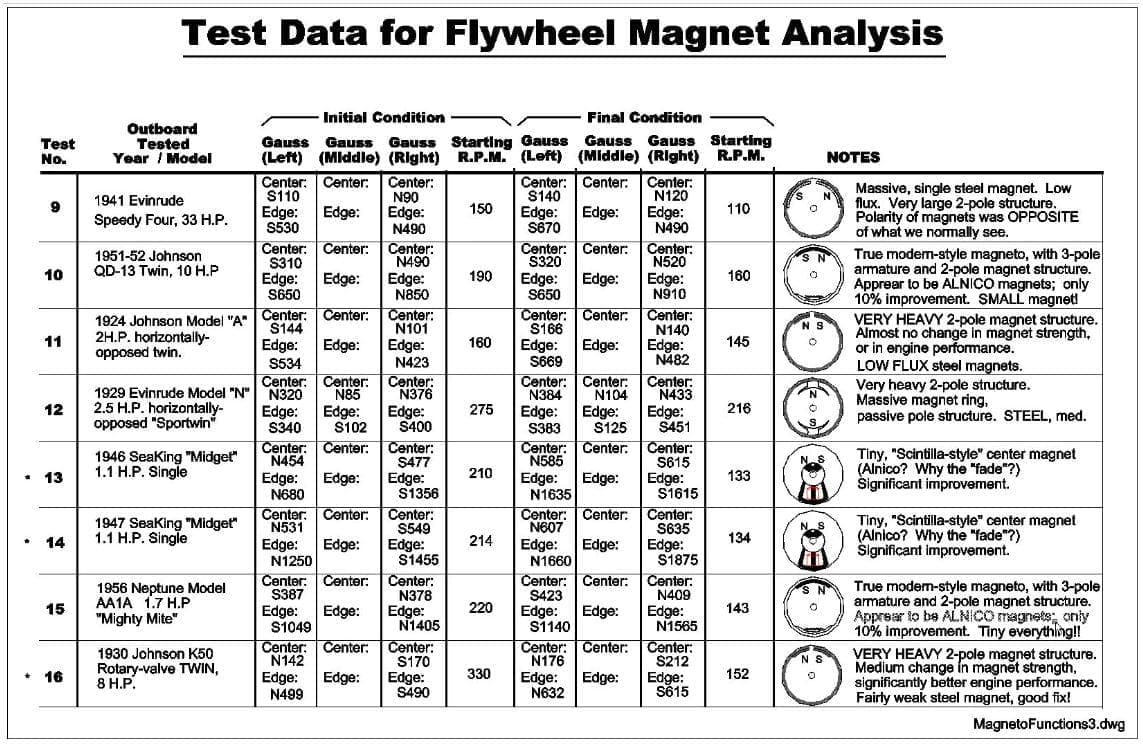
See the attachments below: TestDataPage2.PDF or TestDataPage2.JPG
Look at entry number 16 (at the very bottom of that page). The magnet field strength only increased by about 23%…….yet the outboard
went from needing 330 RPM to generate a spark, down to 152 RPM. This was a DRAMATIC improvement, and made that specific outboard
MUCH, MUCH easier to start.
Again, I’ll repeat…..only about 20 or 25% of the outboards we tested showed this kind of significant improvement…….but in those cases the
improvement was quite large. There’s no way to tell if “recharging” your flywheel magnets will help or not…….but it can’t hurt!
And, that gets me to Mr. Tubs third claim…..that “After WW-II motors have permanent magnets. Attempting to recharge them
will destroy them and they cant be repaired.”
Wow…..this is ABSOLUTELY not true. In the 1920s to 1930s, outboards were built with simple steel magnets. From the late
1930s on, they switched to Alnico (Aluminum Nickel Cobalt) magnets, which had about 4x the field strength. Newer, “rare earth”
magnets like Samarium Cobalt and Neodymium magnets are far stronger than Alnico, but they are also much more expensive, which is why
outboard manufacturers stayed with Alnico.
ALL of these magnetic materials are “permanent magnets”……..and ALL MAGNETS FADE WITH TIME. How much they fade
depends on the magnetic material, the shape of it, nearby magnetic fields, shock / vibration, and heat. And……ALL MAGNETS
CAN BE RECHARGED. ALL OF THEM………you can reverse the polarity of the magnets on a flywheel if you wish, and put them
back with no harm whatsoever. (OK…..Neodymium magnets are formed in such a way that they can hold more magnetic field strength
in one direction than another……but, you can screw them up and restore the correct polarity at full field strength later if you wish.
Not with a Stevens magnetizer, though…..those can only be used to recharge steel and Alnico magnets, not the powerful “rare earth” types).
I think the mistake was that many people thought that old outboard magnets have lost the majority of their magnetism over the last
80 or 90 years……and that recharging them would make them MUCH stronger. In fact, in about 75% of the outboards we tested,
even really old ones, had lost only 20% of their strength or less. “Recharging” them didn’t boost their strength very much. A given magnetic
material can only hold a specific amount of magnetic “charge”……like you can’t charge a 12V battery to 24V! BUT,
as our test results showed, in about 20% of the outboards we tested, even a 20 or 25% increase in magnet strength IN SOME MOTORS
had a significant increase in the performance of the magneto.
This DOES appear to be counter to Faraday’s Law……but, a magneto isn’t a simple single-phase voltage generator, which is what
Faraday’s law describes. It’s beyond my skill in physics to explain why this is the case.
All I can say after all our testing is that recharging flywheel magnets only gave us a significant improvement in about
20% of the motors we tested. IN THOSE CASES, the improvement was dramatic………….but, in about 80% of the time, the
improvement won’t be enough that most people will be able to notice it. SO……..if you can get your magnets recharged
at no cost, go ahead and do it……or, if you can’t get a strong spark and everything else seems to be OK, then try
recharging your magnets as a last resort if you have to pay to have it done. The odds are 1 out of 5 that it will make a big
difference…….but it can’t hurt, and it just might be the “fix” your specific outboard needs. That’s our suggestion!
–Bill Mohat AOMCI, Western Reserve Chapter, Cleveland, Ohio
***********************************************************************
Bill Mohat MS/CIS, BSEET, CCNA
"You can avoid reality, but you cannot avoid the consequences of avoiding reality." --Ayn Rand **********************************************
-
This reply was modified 7 years, 2 months ago by
 Mumbles.